“How much does it cost to start a podcast?” is the wrong question. The honest answer is “anywhere from $200 to $80,000 a year,” and where you land depends almost entirely on one decision: how much of the work you do yourself.
This is the part nobody tells you up front. The microphone is the cheap part. The expensive, recurring part is editing — the unglamorous hours of cutting dead air, balancing levels, writing show notes, and cutting clips, week after week. That’s where the money goes, and that’s where you decide your budget.
Here’s what podcasting actually costs in 2026, broken into the four buckets that matter: gear, software, production (editing), and hosting. Real tools, real price ranges, no fluff.
Gear: $70 to $700, one-time
You need three things to record: a microphone, something to plug it into, and headphones. That’s it. Everything else is optional.
Budget tier (~$70–$150). Start with a USB/XLR dynamic mic. The Samson Q2U (around $60–$80) is the perennial “just get started” pick — it plugs straight into your computer over USB, comes with a desk stand and cables in the box, and sounds dramatically better than a laptop mic or AirPods. The Audio-Technica ATR2100x is the near-identical alternative at a similar price. Add a cheap pair of closed-back headphones ($20–$40) and you’re recording for under $120.
Mid tier (~$250–$400). This is the sweet spot for anyone serious. The Shure MV7+ (about $279–$299) is the most-recommended podcast mic of 2026 for good reason: it has both USB-C and XLR outputs, on-board voice isolation, and it looks good on camera if you’re also shooting video. It grows with you — start on USB, move to XLR later. Pair it with decent monitoring headphones like the Audio-Technica ATH-M50x ($150) and you have a setup that will outlast your first hundred episodes.
Pro tier (~$500–$700+). The classic broadcast move is the Shure SM7B (around $399) — the mic behind a decade of famous podcasts. The catch: it’s XLR-only and needs a lot of clean gain, so you’ll also want an audio interface. The Focusrite Scarlett Solo (4th Gen) ($120) handles a single mic; the RODE PodMic ($99) is a cheaper SM7B-style alternative if you want the broadcast look for less.
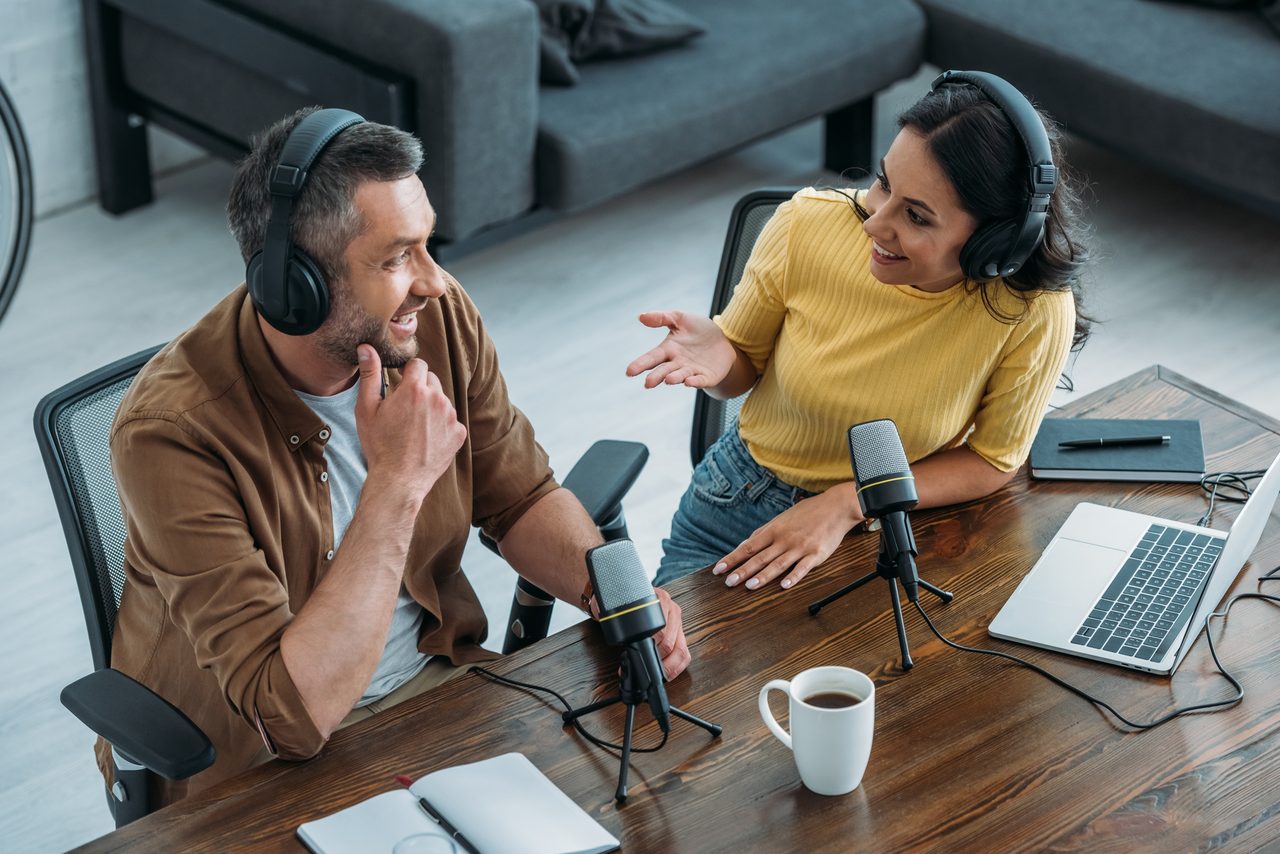
For two people in the same room, skip the simple interface and get a podcast production console like the RODECaster Duo ($449–$499) or the budget Zoom PodTrak P4 ($150). They let you record multiple mics on separate tracks, add sound effects, and record phone-in guests — a real time-saver in editing.
What you can safely skip at the start: a fancy boom arm, acoustic foam, a dedicated SD recorder. A $10 pop filter and recording in a closet full of clothes (yes, really — soft surfaces kill echo) get you 90% of the way for free.
Recording and editing software: $0 to $30/month
Recording software can be completely free. Audacity (free, open-source) and GarageBand (free on Mac) handle basic multi-track recording and editing fine. If you’re recording remote guests, Riverside and Zencastr both record each person’s audio locally in high quality so a guest’s bad Wi-Fi doesn’t wreck the episode — both have free tiers, with paid plans around $15–$29/month.
The bigger decision is your editing tool:
- Descript (from ~$24/month) edits audio like a text document — delete a word in the transcript, it’s gone from the audio. Its AI Studio Sound, filler-word removal, and auto-generated social clips are genuine time-savers. This is the tool most solo podcasters should look at first.
- Riverside (Standard ~$19/month, Pro ~$29/month) bundles recording, text-based editing, one-click audio cleanup (“Magic Audio”), and AI clip generation in one place.
- Audacity ($0) still does the job if you have time and patience and don’t need the AI bells and whistles.
Realistic software cost for a DIY podcaster: $0 to $30 per month. AI editing tools have genuinely collapsed the time cost of self-editing over the last two years — but “faster” still isn’t “free.” Budget three to five hours per episode if you’re doing it yourself, and decide whether your time is better spent elsewhere.
Recording remote guests: don’t use Zoom
Most podcasts in 2026 are interviews, and most guests aren’t in the room with you. How you capture that conversation is the single biggest quality decision you’ll make after buying a mic — and it costs almost nothing to get right.
Why not Zoom or Google Meet? Video-call apps compress audio aggressively and record a single mixed track of whatever the call sounded like in the moment. If your guest’s Wi-Fi hiccups, that glitch is baked permanently into the file. You can’t fix it, can’t separate the voices, and can’t remove crosstalk. It sounds like a phone call because it basically is one.
The fix is “double-ender” recording. Purpose-built tools record each participant’s microphone locally, in full quality, on their own device, then upload those clean tracks to the cloud. Your internet connection only affects the live monitoring — not the recording. You end up with one pristine track per person, which means you can edit each voice independently, balance levels properly, and cut interruptions cleanly. This is the difference between “amateur” and “professional,” and it’s free or near-free.
The two leading tools:
- Riverside (free tier; paid from ~$19/month) records separate audio and up to 4K video tracks per participant, with progressive cloud upload so a crash never loses your recording. It also bundles editing, AI clips, and transcripts — a strong all-in-one.
- SquadCast (free tier with ~5 recording hours/month; paid from ~$12–$24/month) is the lean, audio-first option. Its progressive-upload tech continuously backs up the file in chunks, so even if a guest’s laptop dies mid-sentence you keep everything up to that point.
Both have usable free tiers, so a solo show recording a few episodes a month can capture broadcast-quality remote audio for $0. Step up to a paid plan (~$15–$29/month) when you need more recording hours, 4K video, or team seats. Either way, this is the highest-ROI ~$20 you’ll spend on the whole production.
Production: where the real money is
This is the line item that defines your budget. Three paths:
DIY ($0–$30/episode in software, plus your time). Free if you have the hours. The trap is that editing is the first thing busy founders quietly stop doing — and an abandoned podcast costs more than it ever earned. Be honest about whether you’ll actually keep it up.
Freelance editor ($150–$500/episode). The best value for most independent shows. A US-based freelancer on Upwork or directly will typically charge $150–$500 per episode for a standard interview format — that covers cleanup, leveling, a basic music bed, intro/outro, and often show notes and a few short clips. Rates run roughly $40–$120/hour of work. Narrative shows with heavy sound design run $500–$2,000+ per episode. Overseas freelancers can come in lower, with the usual tradeoffs in turnaround and communication. Many editors offer a monthly bundle — roughly $600–$1,500/month for four episodes is a common sweet spot.
Full-service agency ($1,000–$5,000+/episode). An agency takes the whole thing off your plate: editing, mixing to broadcast loudness, show notes, clips, publishing, sometimes booking guests and strategy. Pricing roughly tiers as:
- Basic / editing-only: ~$500–$1,500 per episode
- Standard branded production: ~$1,500–$4,000 per episode
- Premium / broadcast-grade: $5,000–$15,000+ per episode (studio time, multiple editors, custom music, full marketing)
Most agencies prefer monthly retainers, which usually run $3,000–$25,000/month depending on episode count and scope. (Ranges here are drawn from 2026 agency and freelancer pricing guides; your quote will vary by market and format.)
Hosting: $0 to $99/month
Your podcast needs a host — a service that stores your audio and generates the RSS feed that Apple Podcasts, Spotify, and the rest pull from.
The good news: hosting is cheap and competitive in 2026. Here’s how the four platforms most podcasters actually choose between stack up:
| Platform | Entry price | What you get | Best for |
|---|---|---|---|
| Spotify for Creators | Free | Unlimited hosting, no storage caps, native Spotify video, built-in monetization | Beginners and video-first shows who don’t mind being Spotify-centric |
| Buzzsprout | $19/mo (free 90-day trial) | Tiered by upload hours ($19/$39/$79), dead-simple dashboard, great support, $5–$10 AI/mastering add-ons | First-time podcasters who want the easiest possible on-ramp |
| Transistor | $19/mo | Unlimited shows, episodes, and downloads on every plan; strong analytics; private/team feeds | Anyone running more than one show, or internal/private podcasts |
| Captivate | $19/mo | Growth and marketing tools, networking features, tiers at $19/$49/$99 | Creators focused on audience growth and list-building |
A few notes on the tradeoffs:
- Spotify for Creators is genuinely free and unlimited, which is hard to argue with — but you’re leaning into Spotify’s ecosystem, and its distribution to other apps (Apple Podcasts, Overcast) has historically been less seamless than a dedicated host’s. Great for video; fine for audio.
- Buzzsprout is the friendliest place to start and the one I’d point a nervous first-timer to. Just watch the upload-hour caps — long-form weekly shows can outgrow the $19 tier.
- Transistor wins on value the moment you have (or might have) a second show, because the flat fee covers unlimited podcasts.
- Captivate earns its keep if growth tooling matters more to you than raw simplicity.
Realistic hosting cost: $0 if you go with Spotify, otherwise $19/month. Heavier publishers wanting premium analytics or AI mastering land in the $30–$50 range. Whatever you pick, do not host audio on your own website — it kills page speed and most site hosts will throttle you.
Will it pay for itself? The ROI math
Cost only means something against payback. There are three honest ways a podcast earns back its budget, and they’re not equally realistic for everyone.
1. Sponsorships and ads. This is the one most people imagine, and the one that takes longest to matter. Podcast ads in 2026 are priced on CPM — cost per thousand listens. Typical ranges:
- Pre-recorded spots (up to 60s): ~$15–$30 CPM
- Host-read sponsorships: ~$25–$40 CPM
- High-value niches (B2B, finance): $40–$100+ CPM, because the audience is worth more
Do the math and the catch is obvious. At a $25 CPM with a mid-roll and a pre-roll, a show pulling 1,000 downloads per episode earns roughly $40–$50 per episode — nowhere near a $300 editing bill. Ad revenue only becomes meaningful in the tens of thousands of downloads. For most shows, sponsorships are not the business model; they’re a bonus that arrives late.
2. Lead generation (the founder’s real reason). This is where podcasts actually pay for themselves fast, and it doesn’t depend on audience size. A founder-hosted interview show is a legitimate excuse to get a dream client, partner, or acquisition target on a 45-minute call. One closed deal from a guest relationship can cover a year of production. B2B shows track this with vanity URLs, unique promo codes, and CRM attribution — and a single enterprise contract dwarfs any ad CPM. If you’re a founder, judge the podcast as a pipeline channel, not a media property.
3. Repurposing into content. Every episode is also raw material. One hour of conversation yields a long-form audio episode, 3–5 short video clips for Reels/Shorts/LinkedIn, a transcript you can turn into a blog post and a newsletter, and a dozen quote graphics. AI tools (Riverside, Descript, Opus Clip) auto-generate most of these now. Viewed this way, a $300 editing cost isn’t buying one episode — it’s buying a week’s worth of multi-channel content. That changes the ROI calculation entirely.
The takeaway: if you measure a podcast purely on ad revenue, almost no show “works.” Measure it on relationships closed and content produced, and a modest budget pays back quickly.
Putting it together: three realistic budgets
The bootstrapped solo show
- Gear: ~$120 (Samson Q2U + headphones), one-time
- Software: $0–$24/month
- Hosting: $19/month
- Editing: you
- Year one: roughly $350–$650, mostly your time
The serious independent podcast
- Gear: ~$450 (Shure MV7+ + good headphones), one-time
- Software: ~$24/month (Descript or Riverside)
- Hosting: $19/month
- Editing: freelancer at ~$300/episode, 4 episodes/month = ~$1,200/month
- Year one: roughly $15,000–$18,000
The branded company podcast
- Gear: studio-grade or agency-provided
- Production: full-service agency retainer at $3,000–$8,000/month
- Hosting + tooling: bundled or ~$50/month
- Year one: roughly $36,000–$100,000+
That last tier sounds steep until you compare it to other B2B content channels. A single trade-show booth or a mid-tier paid-search campaign can cost the same, and a branded podcast produces a library of evergreen relationships and content you own outright.
The bottom line
The cost of a podcast in 2026 is whatever you decide to pay for editing. Hosting is free-to-cheap (Spotify for Creators at $0, or ~$19/month elsewhere). Remote recording is free-to-cheap too — and using a double-ender tool instead of Zoom is the easiest quality win there is. Gear is a one-time purchase you can start at $120 and never need to exceed $700 for excellent quality. Software for self-editors tops out around $30/month, and AI tools have made DIY genuinely faster than it was even two years ago.
If you have more time than money, you can produce a legitimately good show for under $700 a year. If you have more money than time — which describes most founders and brands — budget $150–$500 per episode for a freelancer, or $3,000–$8,000 a month for an agency to handle everything. Either way, judge the payback on relationships and repurposed content, not ad CPMs.
The single most expensive mistake isn’t overspending on a microphone. It’s launching, publishing six episodes, and quietly quitting because editing ate your weekends. Pick the budget you can sustain for a year before you buy anything. Consistency is the only production value that compounds.