
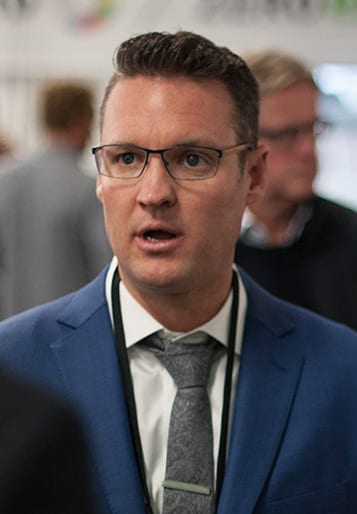
On December 18, 2023, a federal judge sentenced Trevor Milton to four years in prison for defrauding the investors who had made his electric-truck company, Nikola, briefly worth more than Ford. He never served a day of it. He stayed free on bail through his appeal, and on March 27, 2025, President Trump gave him a full pardon — five weeks after Nikola itself had filed for Chapter 11 bankruptcy. Six months after that, Milton was running a company again: CEO of a private-jet maker whose plane, in August 2026, flew coast to coast faster than any aircraft in its class ever had, with Milton strapped in as a passenger.
A truck that was rolled downhill
Milton founded what became Nikola Corporation in 2015, building it from what he’s described as a basement operation in Utah into a company that went public via SPAC merger in June 2020. The stock cleared $93 a share intraday on its first full trading day, and Nikola’s market capitalization briefly topped $30 billion — more, for a few days, than Ford Motor Company, a 117-year-old automaker that actually built and sold vehicles.
Nikola didn’t. On September 10, 2020, the short-seller Hindenburg Research published a report calling Nikola “an intricate fraud,” built on a specific, falsifiable claim: that a 2016 promotional video showing Nikola’s prototype truck appearing to drive under its own power on a highway was actually footage of a non-functioning truck that had been towed to the top of a hill and filmed rolling down it. Prosecutors later told a jury the same thing — that the truck Milton presented to investors as a working vehicle couldn’t drive at all. Ten days after the report, on September 20, 2020, Milton resigned as executive chairman, retaining roughly 91.6 million shares then worth about $3.1 billion.
Convicted, sentenced, and never once in custody
A federal grand jury indicted Milton in July 2021 on securities and wire fraud charges; the SEC filed a parallel civil case the same year. In October 2022, a New York jury convicted him on one count of securities fraud and two counts of wire fraud, finding that he’d lied to investors about “nearly all aspects” of Nikola’s business, not just the truck video. On December 18, 2023, Judge Edgardo Ramos sentenced him to four years in prison, a $1 million fine and $168 million in restitution to the shareholders his statements had misled.
Milton remained free on bail throughout, pending an appeal of the conviction — which is also how he remained free after sentencing. He was never taken into custody. The company he’d built kept sliding without him: Nikola cycled through multiple CEOs, posted years of losses trying to sell electric and hydrogen-fueled semi trucks into a market that wasn’t ready for them, and on February 19, 2025, filed for Chapter 11 bankruptcy in Delaware, listing liabilities as high as $10 billion against roughly $47 million in cash.
The pardon, five weeks later
On March 27, 2025, Milton announced that President Trump had granted him a full and unconditional pardon; the White House confirmed it the next day. Trump’s stated reasoning, as reported by CNN and Fox 13 Salt Lake City, tied the case directly to politics: “They say the thing that he did wrong was he was one of the first people that supported a gentleman named Donald Trump for president,” Trump said. “There are many people like that. They support Trump, and they went after him.” Milton, in a statement posted to X and reported by Fox 10 Phoenix and the Associated Press, wrote: “This pardon is not just about me — it’s about every American who has been railroaded by the government, and unfortunately, that’s a lot of people.”
The pardon didn’t just end the custodial sentence he’d never begun serving. By eliminating the conviction, it also erased the $168 million restitution order to Nikola’s defrauded shareholders — people who, Reuters and the AP both noted, had already lost tens of millions of dollars when the company Milton built collapsed into bankruptcy five weeks earlier. In September 2025, the SEC moved to dismiss its own long-running civil case against him, closing out the last piece of the matter.
Six months later, a new cockpit
In October 2025, SyberJet Aircraft — a small Arizona-based maker of light business jets, tracing its lineage back to Swearingen Aircraft in 1959 — named Milton CEO. He is also a member of the investor group behind the company’s current ownership. SyberJet’s pitch is the SJ30 family of jets, marketed as the fastest and longest-range aircraft in their weight class, plus a newly announced SJ36 targeting certification later this decade.
On August 18, 2026, an SJ30-2 flew nonstop from Jacksonville to San Diego in roughly four hours and seven minutes, averaging about 505 mph — breaking a transcontinental speed record for the aircraft’s class that had stood since 2013. Milton was aboard as the flight was submitted to the National Aeronautic Association for certification. Pilot Gordon Bryan flew it; the company’s CEO, convicted eighteen months earlier of fraud and never having served a day for it, rode in the back.
What founders should actually take from it
The jury’s finding and the pardon are not in tension — a pardon doesn’t erase the verdict, it erases the punishment, and Trump’s own framing never disputed that a jury convicted Milton; it argued the prosecution itself was political. What’s unusual here isn’t that a founder got a second act after a scandal — Silicon Valley does that routinely, on the theory that operational failure and personal conduct are separable questions. What’s unusual is the mechanism: Milton’s second act didn’t require surviving his sentence, serving his time, or repaying the shareholders a jury found he’d defrauded. It required an appeal that kept him out of prison long enough for a presidential pardon to arrive before he ever went in. Whether that’s a quirk of one case or a preview of how white-collar sentences get treated going forward is a question bigger than one jet company — but for Milton personally, the four-year sentence and the $168 million bill were, in the end, numbers that applied to someone else’s timeline, not his.
This is an editorial profile assembled from public court records, regulatory filings, company statements and reporting. Sources: Bloomberg — Nikola Founder Trevor Milton Sentenced to Four Years for Fraud, Fortune — Nikola founder sentenced to prison for exaggerating claims about zero-emission trucks, Reuters via TipRanks — Nikola Corporation Files for Chapter 11 Bankruptcy, Bloomberg Law — Nikola Goes Bankrupt, Capping Troubled EV Maker’s Long Slide, CNN via syndication — Trump pardons Trevor Milton, who was accused of fraud related to bankrupt truck maker Nikola, Fox 13 Salt Lake City — Trump explains pardon of Utah billionaire Trevor Milton, Fox 10 Phoenix — President Donald Trump pardons Trevor Milton, founder of EV startup Nikola, Washington Times/AP — Trevor Milton, Nikola founder, Trump donor gets a presidential pardon, Bloomberg Law — SEC Moves to Dismiss Case Against Former Nikola CEO Milton, Hydrogen Insight — US financial watchdog drops civil charges against former Nikola Motors boss Trevor Milton, Wikipedia — SyberJet Aircraft, Wikipedia — Trevor Milton.


.jpg)