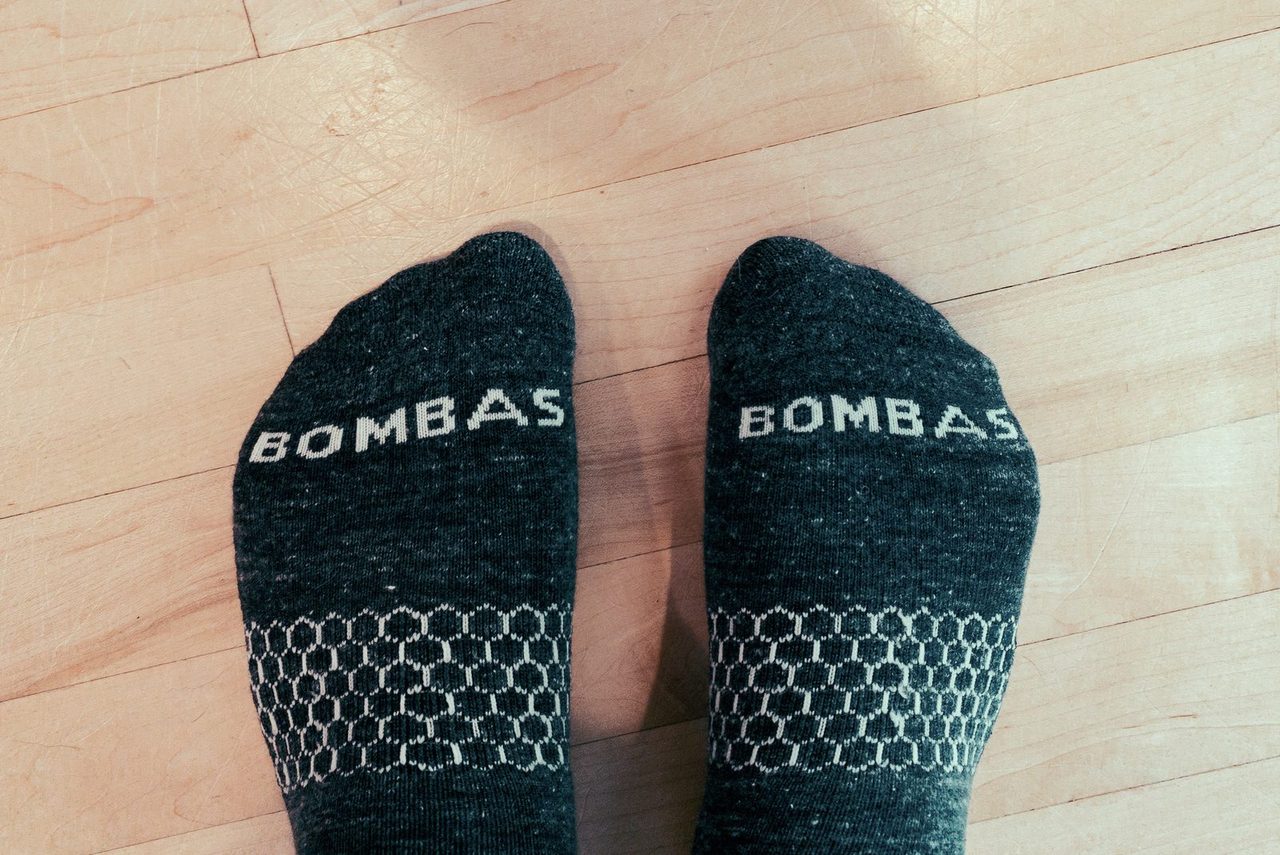
Bombas did get a deal on Shark Tank, though not on its own terms. In the Season 6 premiere, which aired September 26, 2014, Randy Goldberg and David Heath came in valuing their sock company at $4 million and left with Daymond John’s offer: $200,000 for 17.5% of the company, plus financing of the inventory, according to Business Insider. That works out to a valuation of about $1.14 million, well under a third of what they asked. John did invest, and he has called Bombas his best investment. Twelve years later the company is still private, has had a non-founder CEO since May 2025, and says it has passed $2 billion in lifetime sales and 150 million donated items. Those two numbers come from the company, are not audited, and are measured in ways that have changed over time. That is the part worth reading slowly.
Did Bombas get a deal on Shark Tank?
Yes. Business Insider’s 2018 accounts of the episode describe a hostile tank. Kevin O’Leary told the founders that “a $4 million valuation in a total commodity of socks is ludicrous,” and called them “sock cockroaches.” Lori Greiner objected to their plan to spend the money on hiring. Mark Cuban said their sales shouldn’t be plateauing. The deal that came out of it was John’s: $200,000 for 17.5%. At the founders’ own $4 million valuation, $200,000 would have bought 5%; John’s terms gave him three and a half times that.
The founders said they had prepared for exactly this. They told Business Insider they built a spreadsheet of close to 300 questions the Sharks had asked earlier entrepreneurs and rehearsed answers and follow-ups. (Fortune, in 2024, put the figure at about 200.) “If you over-prepare, you’re going to do fine,” Goldberg said. Heath described the insults as part of the format: “at the end of the day, you have to remind yourself that it’s a television show.”
Did the deal close?
The investment happened. Fortune reported in December 2024 that John invested, and Business Insider reported that John told its reporter Richard Feloni that Bombas was his best investment. What is less clear is the final paperwork. Atlanta Black Star reported in 2019 that “the terms were later renegotiated,” but gave no new terms. Neither Bombas nor John has published the closed terms or John’s current stake, as far as we found. The on-air number is the only one on the record. You can check both valuations with our post-money valuation calculator; for why a Shark’s valuation and a founder’s can be that far apart, our guide to how startups are valued covers the mechanics.
Before the tank: a fact about shelters
The founding story has been consistent for a decade. Goldberg and Heath were working at an early-stage media company when they read that socks were the most requested clothing item in homeless shelters, FOX 5 New York reported in 2017. Neither had made a product before. The company was founded in 2013, according to SGB Media, and launched with an Indiegogo campaign that raised more than $140,000 (FOX 5). The name, FOX 5 noted, comes from the Latin for bumblebee.
The pair had decided on a partnership before they had a product. “We decided we wanted to start a business together before we had an idea,” Goldberg told Fortune. Fortune also reported that Heath sold Cutco knives door to door in college and that Goldberg was laid off from a consulting job during a recession.
What happened to Bombas after Shark Tank: the numbers, and whose they are
Most retellings of Bombas on Shark Tank skip straight to the sales figures. Bombas is private and does not publish audited accounts. Every figure below is attributed, and they don’t all measure the same thing:
- 2017: Revenue of “just under $50 million,” and profitable since 2016, Heath told Business Insider.
- 2019: $225 million in sales since the 2014 launch, according to Sony Pictures Television data cited by Atlanta Black Star. That is a cumulative total, not annual revenue.
- October 2023: $1.3 billion in retail sales, as reported by Fortune, which named no source for the figure.
- May 2025: More than $2 billion in lifetime sales, revenue up 22% in the fiscal year through April, and an EBITDA margin described as “super healthy, double digit,” incoming CEO Jason LaRose told CNBC.
The trend is real: the company went from a $50 million year to a claimed $2 billion cumulative in about eight years. But “retail sales,” “lifetime sales” and “revenue” are different measures, and none of the coverage defines them. Treat them as company claims that point in one direction, not as a set of accounts. Heath’s line to CNBC, that Bombas “focused on profitability before it was cool,” is also a claim; the only margin disclosure is LaRose’s unspecific “double digit.”
The one-for-one count, and how its unit changed
The donation pledge is why Bombas exists, and its counter is the company’s most-quoted number. Here is how it has been reported:
- About 2.5 years in, 1 million pairs donated; by August 2017, more than 4 million pairs (FOX 5).
- By 2019, more than 18 million pairs (Atlanta Black Star, citing CNBC).
- By December 2024, more than 100 million “articles of clothing” (Fortune).
- By October 2025, more than 150 million “items” given to community organizations (Retail Dive).
Notice the unit. Early counts were pairs of socks. Later counts are items, because Bombas now donates T-shirts and underwear as well as socks, Retail Dive reported, and sells far more than socks: LaRose said footwear was “probably close to 20% of our business” in 2025. So the jump from 18 million to 150 million is partly growth and partly a broader definition. These are company-reported figures; we found no independent audit of them. Fortune notes Bombas is a certified B Corp.
Who owns Bombas now, and is it still in business?
Bombas is still independent and privately held. We found no acquisition or outside buyer. The largest change was at the top. On May 15, 2025, CNBC reported that Heath was stepping down as CEO to become executive chair, handing the job to Jason LaRose, the company’s president and a former Under Armour executive. “We’ve reached a size and scale that is beyond my expertise,” Heath said.
The new strategy is physical. About 7% of sales came through wholesale partners such as Nordstrom, Scheels and Dick’s, CNBC reported, with a goal of 10% to 20%. Bombas opened its first store, in New York’s West Village, on October 17, 2025 (Retail Dive) and added Target and DSW as partners. By August 2026, SGB Media reported, a Georgetown store in Washington, D.C. would bring the count to five. With wholesale at about 7%, the great majority of sales still come direct to consumers.
What founders can take from it
First, the tank’s valuation turned out not to matter much. Goldberg and Heath gave up 17.5% instead of 5%, and the inventory financing that came with the deal may have been worth more to a young product company than the headline price. Second, preparation is a strategy you can copy. Their 300-question spreadsheet was an attempt, in Heath’s words to Business Insider, “to control the narrative.” Third, read a mission metric’s unit as carefully as a revenue figure: “pairs of socks” and “items” are not the same count. And fourth, Heath’s handover is a useful model. A founder who says the company has outgrown his expertise, and stays on as chair, is making a clearer call than most.
Bombas gave up three and a half times the equity it offered, one of the steepest haircuts in our analysis of Shark Tank deals by the numbers. It ranks fifth among the most successful Shark Tank companies.