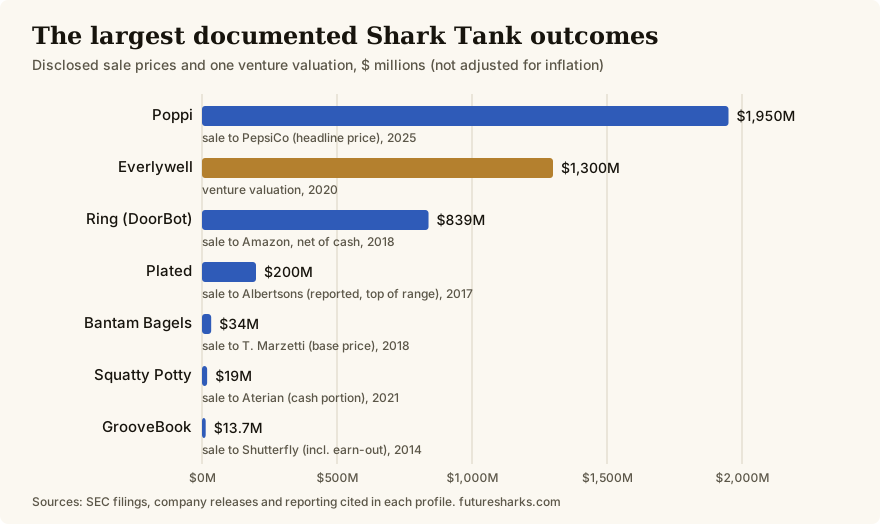
The most successful company ever to pitch on Shark Tank, by any number someone has put their name to, is Poppi. The prebiotic soda, which appeared as Mother Beverage in 2018, was bought by PepsiCo in 2025 for a headline $1.95 billion. After that the order depends on what you count. Everlywell raised money at a $1.3 billion valuation. Ring sold to Amazon for about $839 million, after the Sharks turned it down. Scrub Daddy and Bombas are the largest operating businesses by their own sales figures. This ranking uses only outcomes with a named source: a buyer’s announcement or filing, a funding round, or revenue reported by a credible outlet. It does not use “net worth” estimates, which are guesses dressed as data. Every company links to a full Future Sharks profile with its sources.
How we ranked them
- Documented exits and valuations first. A sale price announced by the buyer, disclosed in an SEC filing or widely reported at the time, or a valuation reported for a priced funding round.
- Then documented operating scale. Annual revenue reported by a credible outlet ranks above company-claimed lifetime sales, which rank above an investor’s promotional totals.
- No net-worth estimates. Figures from “net worth” sites are excluded entirely.
- Shark Tank alumni, with or without a deal. Companies that pitched on the show count whether or not they closed a deal. We say which ones did.
- Only companies we have profiled. This list draws on the 33 companies in our Shark Tank series as of October 28, 2026, so well-known companies we have not yet profiled are missing.
The ranking
1. Poppi — sold to PepsiCo for $1.95 billion (2025)
Allison and Stephen Ellsworth pitched as Mother Beverage in December 2018, asking $400,000 for 10%, and gave guest Shark Rohan Oza 25%. They renamed the company Poppi, and PepsiCo announced in March 2025 that it would buy it for “$1.95 billion, including $300 million of anticipated cash tax benefits for a net purchase price of $1.65 billion.” It is the largest documented outcome from the show. Read the Poppi profile.
2. Everlywell — valued at $1.3 billion (2020)
Julia Cheek asked for $1 million at a $20 million valuation in 2017 and took a credit-line deal from Lori Greiner. Three years later the at-home lab-testing company raised a $175 million Series D that TechCrunch reported valued it at $1.3 billion. It is still private, so that valuation has not been tested by a sale. Read the Everlywell profile.
3. Ring — bought by Amazon for about $839 million net of cash (2018)
Jamie Siminoff pitched DoorBot in 2013, asked $700,000 for 10% and left with nothing. Amazon bought the renamed company in April 2018; its annual report gives the price as “cash consideration of approximately $839 million, net of cash acquired,” less than the “$1 billion” in most retellings. The most expensive “no” in the show’s history. Read the Ring profile.
4. Scrub Daddy — more than $220 million in revenue (2023)
Aaron Krause’s smiley-face sponge took $200,000 from Lori Greiner in 2012. Reuters reported in 2024, citing people familiar with the matter, that the company had more than $220 million in 2023 revenue and was exploring a sale that could value it at “several hundred million dollars.” No sale has been announced. Greiner’s own “$2.9 billion in sales” is a promotional, cumulative figure; we check all nine of her featured companies in Lori Greiner’s Shark Tank deals, checked against the record. Read the Scrub Daddy profile.
5. Bombas — more than $2 billion in lifetime sales, by its own count
Daymond John took 17.5% for $200,000 in 2014. Bombas is still private and says it has passed $2 billion in lifetime sales and 150 million donated items. Those are company figures, not audited ones, but they come with a long public record of retail expansion. Read the Bombas profile.
6. Kodiak Cakes — majority sold to L Catterton (2021)
Joel Clark turned down $500,000 for 50% in 2014. In May 2021 private equity firm L Catterton bought a majority stake; the price was not disclosed, but the companies said revenue had grown more than 50-fold since the Shark Tank appearance. A rumored $800 million value has never been confirmed. Read the Kodiak Cakes profile.
7. Cousins Maine Lobster — $1 billion in systemwide sales since 2012
Barbara Corcoran put $55,000 into a single lobster truck in 2012. The company told Fast Casual in 2025 that it had “surpassed $1 billion in systemwide sales” since its founding. Systemwide sales include franchisees’ revenue, not just the company’s own. Read the Cousins Maine Lobster profile.
8. Dude Wipes — about $100 million a year, by the company’s update segments
Mark Cuban took 25% for $300,000 in 2015. Figures from the company’s Shark Tank updates put lifetime sales at $341 million by October 2023 and annual sales above $100 million. They are unaudited but internally consistent. The company also settled a $9 million class action over its “flushable” claim. Read the Dude Wipes profile.
9. Boarderie — $225 million in sales since 2022, per Lori Greiner
The charcuterie-board company took $300,000 for 9% from Greiner in 2022. Greiner’s website says it has done “$225 Million in sales since airing 3 1/2 years ago,” up from the $50 million she cited in June 2024. That is an investor’s promotional claim with no independent confirmation. Read the Boarderie profile.
10. Plated — sold to Albertsons for a reported $175 million to $200 million (2017)
Plated’s deal with Mark Cuban fell through; Albertsons bought the meal-kit company in 2017 for a reported $175 million to $200 million up front, plus possible earnouts. Albertsons ended the delivery service in 2019. A large exit, followed by a shutdown. Read the Plated profile.
Also documented: smaller sales and strong independents
| Company | What’s documented | Profile |
|---|---|---|
| Tipsy Elves | $125 million in lifetime sales by 2024, per The Hustle; Robert Herjavec calls it his best deal | Tipsy Elves |
| Neuro (NeuroGum) | $135 million in lifetime sales, per the company (2026); no deal on air | Neuro |
| FlexScreen | Acquired by RiteScreen in 2025; terms undisclosed | FlexScreen |
| Bantam Bagels | Sold for a $34 million base price in 2018; the buyer exited the business in 2022 | Bantam Bagels |
| Squatty Potty | Sold to Aterian for about $19 million in cash in 2021; resold in 2026 | Squatty Potty |
| Scholly | Key assets acquired by Sallie Mae in 2023 | Scholly |
| Spikeball | $15 million in sales in 2017, per AFP; deal fell through | Spikeball |
| Cupbop | $18.7 million over 12 months, claimed on air in 2022; still expanding | Cupbop |
| Cup Board Pro | About 75,000 units sold in the first year at Williams-Sonoma, per its manufacturer | Cup Board Pro |
| GrooveBook | Sold to Shutterfly for $13.7 million including an earn-out, nine months after its episode | GrooveBook |
| Wicked Good Cupcakes | Sold to Hickory Farms in 2021; Kevin O’Leary’s royalty reportedly earned him over $1 million | Wicked Good Cupcakes |
| Drop Stop | $24 million in revenue from 2.4 million units by 2017, per CNBC as cited by Wikipedia; later claims run to $100 million | Drop Stop |
| Red Dress Boutique | $14 million to $15 million in 2014 sales; founder bought out Mark Cuban in 2019 | Red Dress Boutique |
| The Woobles | $7 million in 2022 revenue, per Shark Tank Blog; did not close its on-air deal with Cuban and Greiner | The Woobles |
What the successful ones have in common
Three patterns stand out across the list, and they are more useful than the rankings.
- The Shark was rarely the main source of capital. Poppi was funded by Rohan Oza’s firm from seed onward; Everlywell, Ring, Plated and Kodiak raised from venture or private equity after the show. For most of these companies the episode was a marketing event, and the money came later.
- Retail distribution did the heavy lifting. Scrub Daddy, Bombas, Dude Wipes, Kodiak and FlexScreen all grew through national retailers, often introduced or accelerated by a Shark. How to build a consumer brand is a distribution problem before it is a branding one.
- Walking away was not fatal. Two of the top six, Ring and Kodiak, had no deal at all. Our analysis of Shark Tank deals by the numbers shows the Sharks typically pay about half of what founders ask, which is one reason confident founders decline.
And the cautionary tales
Success on the show is not success afterward. Breathometer got $1 million from all five Sharks, then a 2017 FTC settlement over its accuracy claims; Mark Cuban called it his “biggest beating.” Bantam Bagels sold for $34 million, and its buyer wrote the earnout down to zero and closed the business four years later. A sale price tells you what the founders received, not whether the business survived.
Why we don’t rank by “net worth”
Search for almost any Shark Tank company and the first results will quote a “net worth” to the nearest million. Those figures come from sites that do not cite sources and often contradict each other by a factor of ten. A private company’s value is only known when someone buys it, invests at a disclosed price, or files it with a regulator. That is why this list is shorter and more cautious than most, and why several companies that are probably very large, such as Scrub Daddy and Bombas, rank on sales rather than valuation.
This ranking will change as companies sell, raise or report. Last checked October 28, 2026. Thinking about applying? Read our guide on how to get on Shark Tank.