Yes, Poppi got a deal on Shark Tank, though not under that name. In an episode that aired in December 2018, Allison and Stephen Ellsworth pitched an apple cider vinegar drink called Mother and accepted $400,000 from guest Shark Rohan Oza in exchange for 25% of the company. The investment went through: PepsiCo later described the brand as “discovered on Shark Tank by Rohan Oza” and funded by his firm, CAVU Consumer Partners, from its first seed round onward. The company couldn’t trademark the name Mother, so it relaunched as Poppi in 2020. PepsiCo closed its purchase of the business on May 19, 2025. The headline price was $1.95 billion, which shrinks to $1.65 billion once you take out the tax benefits PepsiCo expects to collect. In between came a class action over the drink’s “gut healthy” marketing, which settled for $8.9 million. Poppi is still sold today, and PepsiCo owns it.
What Mother Beverage pitched on Shark Tank
According to the Associated Press, Allison Ellsworth started mixing fruit juice, apple cider vinegar and sparkling water in her kitchen in 2015, because she loved soda and didn’t like how it made her feel. The couple sold the drink at farmers markets. She later described those early days to The Wall Street Journal, and Fortune quoted her: “So we maxed out our credit cards, sold one of our cars to buy bottles, [and] opened our own manufacturing facility.” Per the same account, they put about $90,000 into the business in its first year, and Mother Beverage brought in $500,000 in revenue within 18 months. Those figures are the founder’s own and have not been audited.
Episode recaps by Food Republic and The Daily Meal say the couple asked for $400,000 for 10%, which values the company at $4 million. They also say Kevin O’Leary and guest Shark Bethenny Frankel objected to the Ellsworths making the drink in their own facility instead of using a co-packer, and that Mark Cuban dropped out over how much marketing money a beverage brand needs. Fortune reported that Allison was nine months pregnant when she appeared on the show.
Did Poppi get a deal on Shark Tank?
Yes. Oza was the last Shark still in. He offered the full $400,000 but asked for 25% instead of 10%, and the Ellsworths took it. That valued the company at $1.6 million, well under half of the $4 million they had asked for. (Our post-money valuation calculator does this arithmetic for any ask; for how the two numbers relate, see how to value your startup.)
Plenty of Shark Tank handshakes fall apart after filming. Poppi’s Shark Tank deal didn’t. When Poppi announced a $25 million round in December 2022, its release (published by The Shelby Report) said Oza “first invested in Poppi” after the 2018 appearance and sits on the board. PepsiCo’s acquisition announcement said CAVU had funded the company “from their initial seed round to today.” Fortune described the result of the episode as a $400,000 investment from Oza. We found no published document showing whether the final paperwork matched the 25% agreed on air, but every source we found on the deal treats it as closed.
Why Mother had to become Poppi
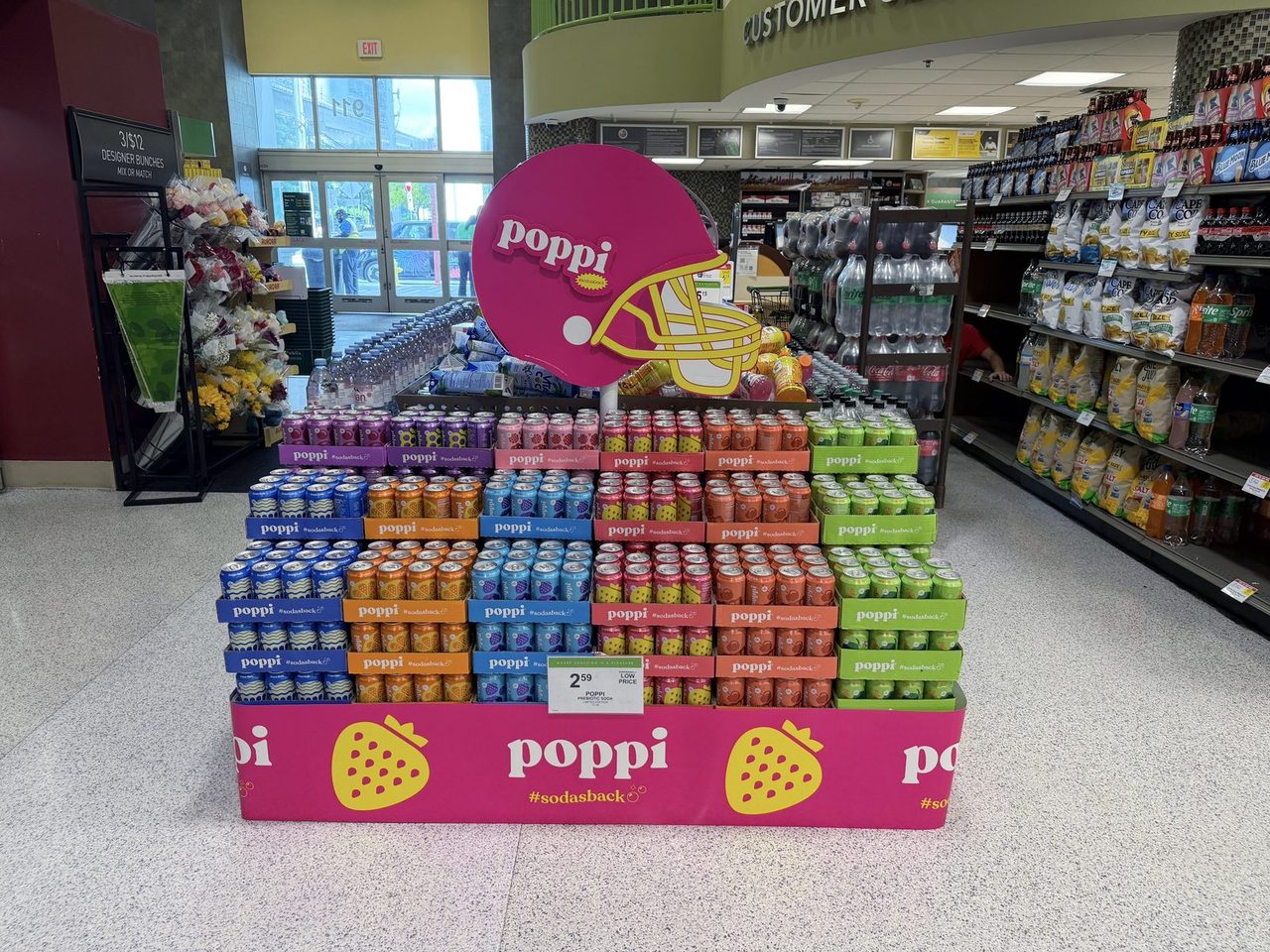
The name couldn’t be protected. In a December 2020 interview with FoodNavigator-USA, Allison recalled Oza telling them on the show, “I absolutely love your liquid, but I hate the packaging.” The magazine reported that Mother “couldn’t be trademarked,” and that the glass bottle suited a farmers market stand but got lost on a grocery shelf. She worked with CAVU’s in-house creative team and the design agency Zero to turn it into Poppi, a “prebiotic soda” sold in brightly colored cans.
The cans reached stores in March 2020, just as the pandemic arrived. Stephen, then CEO, told the magazine: “Our big debut was supposed to be at Expo West… which didn’t happen, so we had to be creative.” The company relied on Amazon and Instagram instead. At the end of 2020 it said it was in about 2,000 stores and expected to reach more than 16,000 in 2021. Both are company figures.
What happened to Poppi after Shark Tank
Poppi grew mostly on social media, TikTok above all, with Allison as the face of the brand. In its December 2022 funding announcement, the company said revenue had grown 148% and online sales 250% over the previous year, and it set a goal of more than 30,000 stores by the end of 2023. Fortune reported that celebrities including Olivia Munn, Post Malone, Alix Earle and Nicole Scherzinger had invested. The company told Fortune its 2024 revenue was more than $500 million. Poppi was private at the time, so that number comes from the company, not from audited accounts.
The gut-health lawsuit and the $8.9 million settlement
The health message was there from the start. In 2020, FoodNavigator-USA noted that the can carried the phrase “for a healthy gut” on the front, while the Ellsworths said they “don’t claim to be experts on ACV or fiber or prebiotics.”
In May 2024, consumer Kristin Cobbs sued VNGR Beverage LLC, the company behind Poppi, in federal court in Northern California. Other suits were later folded into hers as In re VNGR Beverage, LLC Litigation (No. 4:24-cv-03229). The court later summarized the plaintiffs’ argument: each Poppi contains at most two grams of prebiotic fiber, so a drinker would need more than four sodas a day for 21 straight days to notice any effect, and the sugar in that many cans would cancel most of the benefit. The AP reported that Poppi denied the claims and said it had already removed “gut health” references from its packaging in late 2023. The company’s statement on the settlement, quoted by Fortune, said Poppi “acknowledges no fault, liability or wrongdoing.”
The settlement created an $8.9 million fund. Buyers could claim $0.75 per can, or up to $16 per household without receipts. Judge Haywood S. Gilliam Jr. granted final approval on April 14, 2026. His order shows how much interest the settlement drew. As of October 17, 2025, the claims administrator had about 2.5 million claims without receipts that appeared valid pending review, 38,542 claims with receipts, and 1.8 million submissions it had flagged as fraudulent. In June 2026 the judge awarded class counsel $2,225,000 in fees, less than the $2.67 million they had asked for, plus $23,593.48 in expenses. He gave each named plaintiff $100 instead of the $5,000 requested. Final judgment was entered on June 15, 2026.
What PepsiCo paid, and what the founders got
PepsiCo announced the deal on March 17, 2025, at “$1.95 billion, including $300 million of anticipated cash tax benefits for a net purchase price of $1.65 billion.” It added a possible earnout tied to performance targets after closing, and did not disclose the earnout’s size. Chairman and CEO Ramon Laguarta said “poppi is a great complement to our portfolio transformation efforts to meet these needs.” Allison was quoted in the release: “When I created poppi in our kitchen, it was fueled by a desire to create a better-for-you soda.” The deal closed on May 19, 2025.
Note which number you’re reading. “$2 billion” headlines round up the gross figure, while $1.65 billion is what PepsiCo says it actually paid net of the expected tax savings. PepsiCo has not said how the money was split among the founders, CAVU, Oza and the celebrity investors. In a May 2026 piece drawing on her Journal interview, Fortune reported that the sale put more than $100 million in the couple’s pockets. Neither the company nor PepsiCo has confirmed that figure. Allison told Fortune in 2025, “From day one, we knew that this [selling the company] was always something we wanted to do,” and said PepsiCo made the first approach. On what PepsiCo’s distribution gives the brand: “Now we have a Ferrari underneath us for distribution.”
Who owns Poppi now, and is it still in business?
PepsiCo owns Poppi, and the brand is still on sale. Chris Hall was Poppi’s CEO when the deal closed. Fortune reported that Allison stayed with the brand as a creative advisor. PepsiCo launched Poppi in the UK on March 5, 2026, with distribution by Carlsberg Britvic, starting in Tesco and Pret, according to BeverageDaily. In the US you can buy it in supermarkets or on Amazon, where packs like The Classics 12-pack are sold. Asked in April 2026 how the new owner is treating the brand, Allison told Fortune: “they’ve been really big on ‘let Poppi be Poppi,’” adding, “I think they’re actually trying to learn from us.”
Poppi prebiotic soda, The Classics 12-pack
What founders can take from it
First, a Shark Tank valuation is where a negotiation starts, not a verdict on the company. The Ellsworths asked for a $4 million valuation, accepted $1.6 million from the investor best placed to help them, and sold for $1.65 billion net seven years later. What Oza brought wasn’t really the $400,000. It was CAVU’s creative team, which rebuilt the brand from scratch.
Second, check whether you can trademark your name before you build a brand on it. Mother Beverage had to rebuild its name, packaging and format right after its biggest moment of publicity.
Third, health claims can come back after the sale. The gut-health message helped sell the cans, then cost $8.9 million to resolve. Poppi had already dropped the wording from its packaging before the suit settled.
Finally, read the headline price the way you would read a term sheet. Separate the gross figure, the net figure and the earnout, and remember that the founders’ share is a different number from all three.