Shark Tank deals are real, but they are not what the episode shows. A handshake on air is the start of due diligence, not a signed investment, and the price is almost always lower than the founder hoped. We wanted to know by how much, and how often a televised deal actually turns into money, so we compiled the numbers from the 33 Shark Tank companies Future Sharks has profiled from the public record. Each figure below links back to a profile where it is sourced: episode recaps, company releases, SEC filings and reporting.
The short answer
- Founders get about half the valuation they ask for. In the 21 deals where both the ask and a cash-for-equity deal are known, the deal valued the company at a median 56% of the founder’s own valuation.
- Founders give up about twice the equity they offer. The median deal took 2 times the percentage the founders put on the table. Bombas offered 5% and gave 17.5%; Legacy Shave offered 10% and sold 95%.
- Most deals close, but not all. Of 29 deals made on air, 20 are documented as closed, 2 closed on different terms, 3 fell through, and 4 have never had final terms made public.
- No deal is not a death sentence. Four companies in the set left without a deal. Two of them, Ring and Kodiak Cakes, are among the largest outcomes in the whole group.
How we built this
- The sample. Every Shark Tank company with a Future Sharks profile as of October 28, 2026: 33 companies whose episodes aired between 2011 and 2022. They are not a random sample. We profiled companies people search for, which skews toward famous successes and famous failures.
- The ask. The amount and percentage the founders asked for on air, as reported in the episode recaps and press cited in each profile. Three profiles (Daisy Cakes, Tipsy Elves and Squatty Potty) have no reliably reported ask, so they are left out of the valuation comparison.
- The deal. The terms accepted on air. For the valuation comparison we only used straight cash-for-equity terms: amount divided by equity. Deals built on credit lines (Everlywell, FlexScreen), on royalties or licensing rights instead of equity (Wicked Good Cupcakes, GrooveBook), with an undisclosed final percentage (Bantam Bagels) or with no deal at all are excluded from that comparison and kept in the closing analysis.
- Closing. “Closed” means a source after the episode documents the investment: the investor’s portfolio or website, a company release, a filing or a founder’s own account. “Not documented” means we found no such source; it does not mean the deal failed.
- Status. What each company is doing in October 2026, from the profile’s most recent checks.
Finding 1: the Sharks pay about half the founder’s price
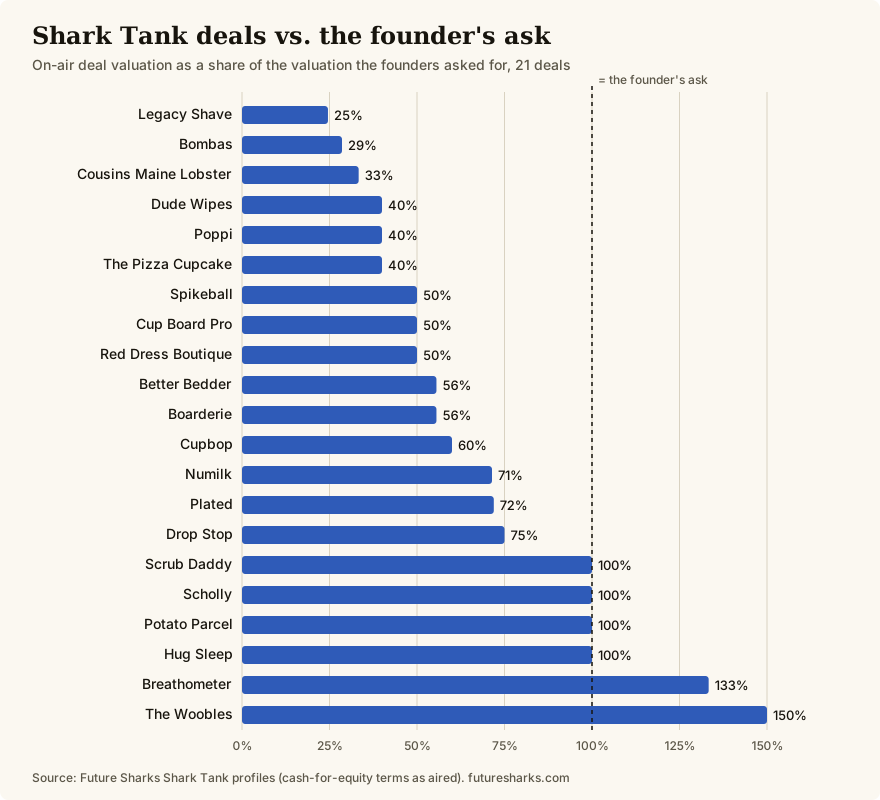
Fifteen of the 21 deals valued the company below the founder’s ask. Four matched it exactly: Scrub Daddy, Scholly, Potato Parcel and Hug Sleep, though Potato Parcel’s came with a royalty on top and Scrub Daddy’s and Hug Sleep’s doubled the money and the equity together. Two priced the company higher than the founders did, and neither turned into a successful investment. At Breathometer, all five Sharks put in $1 million for 30% against an ask of $250,000 for 10%; its products are no longer on sale, after a 2017 Federal Trade Commission settlement over its accuracy claims. At The Woobles, a bidding war ended at $450,000 for 6% against an ask of $250,000 for 5%, and the deal never closed.
The arithmetic behind each bar is simple. A founder who asks for $200,000 for 5% is valuing the company at $4 million. A Shark who offers $200,000 for 17.5% is valuing it at about $1.14 million. Our post-money valuation calculator does that sum for any ask, and our guide to how to value a startup explains why early valuations are so soft.
Finding 2: founders give up about twice the equity they offer
Measured as equity rather than valuation, the median deal took twice the percentage the founders offered. The range is wide:
| What the founders offered | What they gave | Company |
|---|---|---|
| 10% | 95% | Legacy Shave |
| 5% | 17.5% | Bombas |
| 5% | 15% | Cousins Maine Lobster |
| 10% | 25% | Dude Wipes, Poppi |
| 5% | 15% including advisory shares | The Pizza Cupcake |
| 10% | 20% | Spikeball, Cup Board Pro, Scrub Daddy, Hug Sleep |
| 5% | 20% on air (15% as closed) | Red Dress Boutique |
| 15% | 20% | Drop Stop |
| 5% | 9% | Boarderie |
Later results don’t track the size of the haircut. Bombas gave up three and a half times the equity it offered and grew into one of the best-known consumer brands from the show. Poppi gave up two and a half times and sold to PepsiCo. What the haircut buys, when it buys anything, is a Shark’s distribution and attention.
Finding 3: most deals close, and the exceptions are instructive
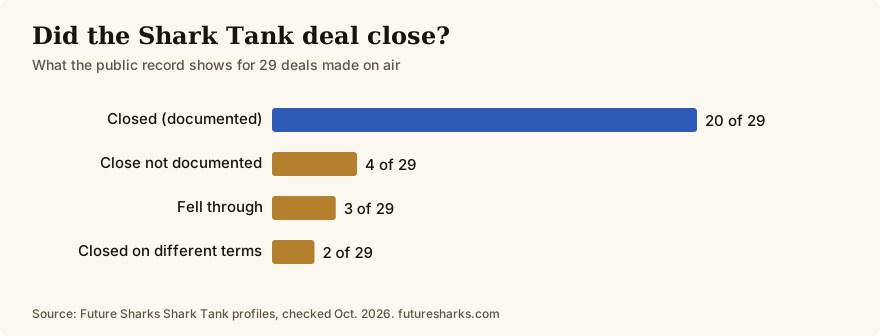
Twenty of the 29 deals made on air, 69%, are documented as closed on the terms shown. The others fall into three groups:
- Fell through (3). Plated grew so fast after taping that its founders wanted to renegotiate Mark Cuban’s terms; they took Kevin O’Leary’s money instead. Spikeball’s deal with Daymond John came with control of licensing, manufacturing and retail, and fell apart over strategy. The Woobles’ founders decided against closing with Cuban and Lori Greiner, according to Cuban’s account.
- Closed on different terms (2). Better Bedder’s equity deal with Lori Greiner became a licensing agreement. Red Dress Boutique’s $1.2 million from two Sharks became $600,000 from Mark Cuban alone.
- Never documented (4). Cupbop, Legacy Shave, Hug Sleep and Numilk all have some evidence of a continuing relationship, or at least no evidence of a collapse, but none has published final terms. Cupbop, for example, is not among the 173 companies on Mark Cuban’s own portfolio site.
That pattern is close to what the Sharks have said themselves. Kevin O’Leary has estimated that about 20% of handshake deals are never executed, and Robert Herjavec that about 90% of those withdrawals come from the entrepreneur, according to the New York Post and Forbes reporting summarized on Wikipedia. In our sample, at least 5 of 29 deals (17%) did not close as aired, and up to 9 of 29 (31%) cannot be shown to have closed as aired.
Finding 4: the deal on screen is often not a plain equity deal
The headline “X dollars for Y percent” hides a lot of structure. In this group alone:
- Royalties. Kevin O’Leary’s Potato Parcel deal paid him per potato until he had collected $150,000, three times his investment. Barbara Corcoran’s Daisy Cakes deal added $1 a cake. O’Leary’s Wicked Good Cupcakes deal was all royalty: $1 a cupcake until repaid, then 45 cents forever.
- Credit lines. Lori Greiner’s Everlywell and FlexScreen deals were built partly or wholly on credit rather than cash.
- Advisory shares. The Pizza Cupcake’s 12.5% came with 2.5% more in advisory shares.
- Licensing. GrooveBook’s Sharks bought 80% of its licensing rights, not equity. Cup Board Pro became a Williams-Sonoma exclusive made by a Wisconsin manufacturer; Better Bedder became a license.
- A buyout. Legacy Shave agreed to sell Greiner 95%.
If you are comparing your own term sheet with what you saw on television, model each of these separately. Our startup dilution calculator handles the equity; a royalty or a credit line is a cash cost that never shows up on a cap table.
Finding 5: some of the biggest outcomes came from “no”
Four companies in the set walked out with nothing: Ring, Kodiak Cakes, Coffee Meets Bagel and Neuro. Ring sold to Amazon in 2018 for about $839 million net of cash, according to Amazon’s annual report. Kodiak Cakes sold a majority stake to L Catterton in 2021 after revenue grew more than 50-fold. Coffee Meets Bagel turned down Mark Cuban’s $30 million buyout talk and is still independent. Neuro declined offers and later brought in Daniel Lubetzky as a partner. This is the clearest place where our sample’s bias matters: we profiled these companies because they became well known. Plenty of companies that leave without a deal disappear, and nobody writes about them. Our ranking of the most successful Shark Tank companies sets the documented outcomes side by side.
The full data
| Company | Aired | Ask (valuation) | Deal on air | Closed? | Status, Oct. 2026 |
|---|---|---|---|---|---|
| Daisy Cakes | 2011 | Not reported | $50K for 25% + $1/cake royalty (Corcoran) | Yes | Active |
| Scrub Daddy | 2012 | $100K for 10% ($1M) | $200K for 20% (Greiner) | Yes | Active |
| Cousins Maine Lobster | 2012 | $55K for 5% ($1.1M) | $55K for 15% (Corcoran) | Yes | Active |
| Drop Stop | 2013 | $300K for 15% ($2M) | $300K for 20% (Greiner) | Yes | Active |
| Wicked Good Cupcakes | 2013 | $75K for 20% ($375K) | $75K for a per-cupcake royalty (O’Leary) | Yes | Acquired by Hickory Farms (2021) |
| Breathometer | 2013 | $250K for 10% ($2.5M) | $1M for 30% (all five) | Yes | Products discontinued |
| Ring (DoorBot) | 2013 | $700K for 10% ($7M) | No deal | — | Acquired by Amazon (2018) |
| Tipsy Elves | 2013 | Not reported | $100K for 10% (Herjavec) | Yes | Active |
| GrooveBook | 2014 | $150K for 20% ($750K) | $150K for 80% of licensing rights (Cuban, O’Leary) | Yes | Acquired by Shutterfly (2014); service later ended |
| Kodiak Cakes | 2014 | $500K for 10% ($5M) | No deal | — | Majority sold to L Catterton (2021) |
| Plated | 2014 | $500K for 4% ($12.5M) | $500K for 5.56% (Cuban) | No, fell through | Acquired (2017), delivery ended (2019) |
| Bombas | 2014 | $200K for 5% ($4M) | $200K for 17.5% (John) | Yes | Active |
| Red Dress Boutique | 2014 | $600K for 5% ($12M) | $1.2M for 20% (Cuban, Herjavec); closed as $600K for 15% (Cuban) | On different terms | Active; founder bought out Cuban (2019) |
| Squatty Potty | 2014 | Not reported | $350K for 10% (Greiner) | Yes | Acquired (2021), resold (2026) |
| Scholly | 2015 | $40K for 15% ($267K) | $40K for 15% (John, Greiner) | Yes | Acquired by Sallie Mae (2023) |
| Coffee Meets Bagel | 2015 | $500K for 5% ($10M) | No deal | — | Active |
| Bantam Bagels | 2015 | $275K for 11% ($2.5M) | $275K (Greiner); final equity not published | Yes | Acquired (2018), closed (2022) |
| Spikeball | 2015 | $500K for 10% ($5M) | $500K for 20% (John) | No, fell through | Active |
| Dude Wipes | 2015 | $300K for 10% ($3M) | $300K for 25% (Cuban) | Yes | Active |
| Potato Parcel | 2016 | $50K for 10% ($500K) | $50K for 10% + royalty (O’Leary) | Yes | Active |
| Everlywell | 2017 | $1M for 5% ($20M) | $1M credit line + 5% (Greiner) | Yes | Active |
| Cup Board Pro | 2018 | $100K for 10% ($1M) | $100K for 20% (all five) | Yes | Active (licensed) |
| Poppi | 2018 | $400K for 10% ($4M) | $400K for 25% (Rohan Oza) | Yes | Acquired by PepsiCo (2025) |
| FlexScreen | 2020 | $800K for 6% ($13.3M) | $400K cash + $400K credit (Greiner) | Yes | Acquired by RiteScreen (2025) |
| Neuro (NeuroGum) | 2020 | $750K for 5% ($15M) | No deal | — | Active |
| Hug Sleep | 2020 | $150K for 10% ($1.5M) | $300K for 20% (Cuban, Greiner) | Not documented | Active |
| The Pizza Cupcake | 2021 | $125K for 5% ($2.5M) | $125K for 12.5% + 2.5% advisory (Greiner) | Yes | Active (now Incredifulls) |
| Better Bedder | 2021 | $150K for 10% ($1.5M) | $150K for 18% (Greiner) | On different terms | Active (licensed) |
| Numilk | 2021 | $1M for 5% ($20M) | $1M for 7% + $1M loan (Cuban) | Not documented | Active |
| The Woobles | 2022 | $250K for 5% ($5M) | $450K for 6% (Cuban, Greiner) | No, fell through | Active |
| Cupbop | 2022 | $1M for 3% ($33.3M) | $1M for 5% (Cuban) | Not documented | Active |
| Boarderie | 2022 | $300K for 5% ($6M) | $300K for 9% (Greiner) | Yes | Active |
| Legacy Shave | 2022 | $300K for 10% ($3M) | $700K for 95% (Greiner) | Not documented | Active |
Questions people ask about Shark Tank deals
Are Shark Tank deals real?
Yes, but the handshake on air is not binding. Due diligence follows, and either side can walk away. In our sample, 20 of 29 on-air deals are documented as closed and at least 5 did not close as aired.
Do the Sharks use their own money?
According to the show’s disclaimer, as summarized on Wikipedia, the money invested is the Sharks’ own, and the Sharks are separately paid as cast members.
How much equity do the Sharks usually take?
In our sample, the median deal took twice the equity the founders offered and valued the company at 56% of the founder’s ask. Deals ranged from exactly the percentage offered (Potato Parcel, Scholly) to 95% (Legacy Shave).
Does the show itself take equity?
Not any more. Early contestants signed an agreement giving the producer the option of a 2% royalty or a 5% equity stake. Wikipedia, citing Inc., reports that the requirement was dropped retroactively in October 2013 after pressure from Mark Cuban.
What happens if a deal falls through?
The company keeps the exposure from the episode, which is often worth more than the money. Spikeball’s deal fell apart and it reached $15 million in sales by 2017; Plated’s fell through and it sold to Albertsons three years later.
Methodology note: figures are as reported in each linked profile and its sources, checked October 28, 2026. Valuations are simple post-money arithmetic (amount ÷ equity) and ignore royalties, loans and advisory shares unless stated. Want to apply? Read our guide on how to get on Shark Tank.