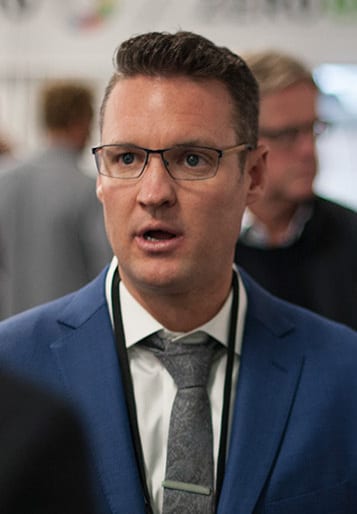
Sebastian Siemiatkowski has one very good argument and he has been making it for two decades. The credit card, in his telling, is engineered to keep you borrowing — a revolving balance, a minimum payment, an interest rate nobody reads. In January 2026 he took that case onto American television, telling CNBC that cards lure customers into debt traps and backing a statutory cap on card rates.
The awkward part of Klarna’s 2026 is that its fastest-growing product is a loan that charges interest.
What he actually built
Siemiatkowski was born in Uppsala in 1981 to Polish parents who had arrived in Sweden the year before. He started Klarna in 2005, aged 23, with Niklas Adalberth and Victor Jacobsson, after working in sales for a company handling receivables for small businesses — the vantage point that produced the original idea, per his biography.
The mechanic was genuinely not a credit card. The shopper receives goods and pays afterwards; the merchant pays Klarna a fee for the conversion lift. Merchant-funded credit is a structurally different bargain from consumer-funded credit, and for fifteen years that distinction was the whole company.
It scaled. Klarna’s full-year 2025 results show $127.9bn of gross merchandise volume, $3.5bn of revenue, 118 million active consumers and 966,000 merchants — against an adjusted operating profit of $65m and a full-year loss per share of $0.79.
The valuation round trip
In June 2021 a SoftBank-led round valued Klarna at $45.6bn. Thirteen months later it raised $800m at $6.7bn, an 85% cut and one of the more brutal repricings of the era.
Getting out took another three years, and a fight. In October 2024, weeks before the first confidential filing, shareholders voted to remove director Mikael Walther; Walther told Bloomberg he was pushed out after he and co-founder Jacobsson challenged a proposed pay award for Siemiatkowski. Bloomberg reported the board sought his removal amid a clash between the two founders over how Klarna would list and who would control it afterwards.
Klarna listed on the NYSE on 10 September 2025 at $40 a share, raising about $1.4bn at roughly a $15bn valuation. The stock opened at $52. Siemiatkowski sold nothing and kept about 7.5%.
On 7 August 2026 the shares closed at $19.90, a market capitalisation of $7.5bn, inside a 52-week range of $12.06 to $57.20.
The number that broke the listing
The unravelling has a date. On 18 November 2025 Klarna reported record Q3 revenue of $903m — and an $83m net loss, driven by provisioning against its expanding “Fair Financing” instalment book, whose US volume grew 244% year on year.
A securities class action followed in the Eastern District of New York on 24 December 2025, filed by Hagens Berman, alleging the IPO documents understated credit risk from lending to financially stretched borrowers and citing a 102% jump in the credit-loss provision. Those are allegations, untested in court.
Klarna’s answer is accounting, not denial. CFO Niclas Neglén has argued the company books expected losses upfront under IFRS 9 while earning revenue across the life of a longer loan; Payments Dive reported that analysts at Wells Fargo and Wedbush broadly accepted this as a timing effect rather than impaired economics. Q1 2026 supports them somewhat: $1.0bn revenue, $1m of net income, provisions at 0.55% of GMV against 0.54% a year earlier.
Both things can be true. The accounting is orthodox and the mix shift is real — and a company earning interest on longer-duration consumer loans is a lender, valued like one.
The AI claim, and the retraction
In February 2024 Klarna announced its OpenAI-powered assistant had handled 2.3 million chats in a month, two-thirds of its support volume, doing work equivalent to 700 full-time agents and worth an estimated $40m of profit improvement. Headcount went from 6,011 at the end of 2022 to 2,831 at the end of 2025.
By May 2025 Siemiatkowski had told Bloomberg the cost-cutting went too far, conceding that treating cost as the dominant variable produced, in his words, “lower quality” — and Klarna began recruiting human agents again.
The contested part is causation. The 700 figure described work volume, not people dismissed; the headcount fall came substantially through a hiring freeze and attrition, which Siemiatkowski has himself said. Critics reasonably note that Klarna spent a year enjoying the harsher interpretation without correcting it.
Regulation arrived anyway
From 15 July 2026 the FCA regulates buy-now-pay-later in the UK: proportionate affordability checks, the Consumer Duty, and access to the Financial Ombudsman. The FCA puts the UK market at over £13bn in 2024, up from £0.06bn in 2017, with 10.9 million adults using it.
The US went the other way. The CFPB announced in May 2025 it would not prioritise enforcement under its 2024 interpretive rule treating BNPL as credit-card lending, and later withdrew it. Klarna also absorbed a SEK 500m Swedish fine in December 2024 for anti-money-laundering deficiencies.
What the story demonstrates
Siemiatkowski was right about the incumbent. Card economics do reward balances that never clear, and building a merchant-funded alternative was a real insight, executed for two decades at enormous scale.
But being right about your enemy’s flaw is not the same as being permanently immune to it. Growth eventually demanded bigger tickets, longer durations and interest income — and each of those moved Klarna closer to the product it was founded to replace. That is the pattern worth stealing from this story, and it is not a flattering one: the constraint you launch with is a marketing position until it survives the first quarter where honouring it would cost you the number.
This is an editorial profile assembled from public reporting, regulatory publications and Klarna’s own disclosures. Sources: Klarna Investor Relations, CNBC, TechCrunch, Bloomberg, Payments Dive, the FCA, Finansinspektionen and the CFPB.